My first love was science fiction, and my second love was politics. I'm cultivating a new love now that will encompass both, and I'm open to the journey.
Long Beach, some of y’all found me watching that storm roll through. You came for the water, the weather, and whatever the Pacific was getting up to. Glad you stayed.
I’m your Unc Adept. And I’ve got an invitation for you.
When you see me on the balcony, wave. That’s it. Throw your hand up. I’ll throw mine back.
My father’s people came from Alabama. My mother’s from Georgia. In our families, sitting outside at the end of the day meant you acknowledged the people passing by. A wave to a car. A hello to somebody walking. Sometimes they stopped. Sometimes they kept right on going.
Either way, we’d seen each other.
Back in 2015, I carried that habit to the end of my Altadena driveway. Took my observing chair, Stargazer, and started waving.
That chair had already helped me explore the universe. I had a ten-inch telescope, binoculars, and an observing diary. Then I turned my attention toward another universe: the neighbors.
I wondered whether Los Angeles would wave back. Well, people circled their cars around. Children wanted their parents to drive past. Bus drivers and passengers joined in. Amy the jogger became a friend.
Within a week, I’d made at least ten new friends. Somebody even asked about bringing a second chair.
Now that’s when you know you’ve got something. Somebody wants to sit beside you and join the welcome.
The Eaton Fire destroyed our home. Stargazer burned on the porch. My telescope equipment, observing diary, and years of records were among the losses.
I miss what we lost. The chair burned. The invitation didn’t.
Sweetie and I traveled across North America, and eventually found our new home here in Long Beach. We call it the Node.
It terraces toward the beach, with balconies looking out over the Strand and the Pacific. People walk, jog, cycle, and carry on with their day right in front of us.
I’ve got my chair, my beverage, and my music. A Southern porch on the Pacific. And this view can wave back.
One Fourth of July, I went outside thinking about a car parked by a tow-away sign. Met a father and son who’d come for the fireworks.
That could have been a very short conversation about parking. Instead, it turned into pizza, Sweetie’s charcuterie, fresh figs, and fireworks over the water.
Y’all come through. Sometimes a little room for somebody changes the whole evening.
Then there’s Jordan. I met her selling her rolls from a wagon on a Long Beach sidewalk. Showing up, setting up, and betting on herself.
So I bought. Jordan runs 4C Rolls N Sweets, and she’s also a caregiver. Taking care of people in more ways than one.
And that sweet potato roll? That wasn’t dessert. That was ancestral technology.
Communities get stronger when we support people who are building something of their own. Sometimes connection looks like a wave. Sometimes it tastes like cinnamon.
I remember names. Ask about somebody’s world. Say hello to the dog, too. I go out with my grabber and pick up litter around our frontage. We share this place. Might as well take care of it, and each other.
When I taught, a high-five with Mr. Johnson meant we’d shared a purpose. Students could come back years later and throw that hand up again.
Membership never expires.
That’s the spirit of the Festival of Continuous Funk. No schedule. No registration. No ticket. Just an invitation that’s there when the opportunity presents itself.
You don’t have to know me. You don’t have to stop. You don’t have to agree with a thing I say. And you certainly don’t have to like whatever I’m playing.
Just throw your hand up. I’ll throw mine back.
Maybe next time we’ll know each other’s names. Maybe something wonderful will happen that neither of us planned.
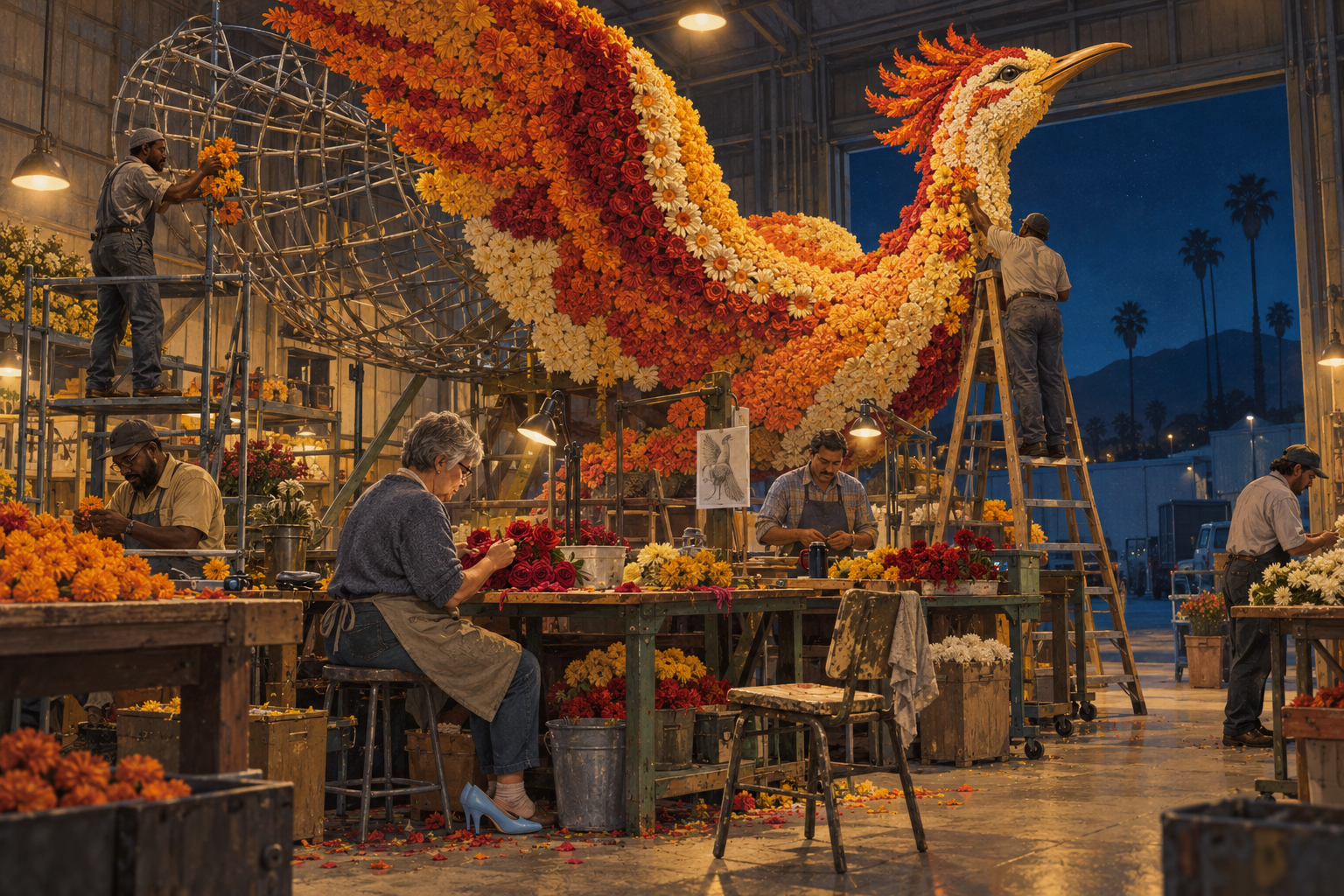
I’ve been carrying this world with me for years: the float lot, the flowers, the people who knew how to make something enormous and delicate arrive on time.
Now it has a name. Petals.
At Alden Floral, twelve Rose Parade floats are already sold. The next January is coming before this one has quite finished. Designers draw. Florists know the color before they know the flower. The mechanic keeps the old rigs moving. There is always work, and there is room inside that work for a life.
The story follows a year among queer artists and craftspeople in Southern California, from one parade into the next. There are arguments over beauty, sandwiches eaten standing up, powder-blue heels, extraordinary competence, and chairs pulled out for people who need somewhere to sit.
This is fiction, nourished by a world I knew. The people in these pages have their own lives.
I’m putting the whole book into the world now. You don’t need an invitation, a deadline, or a review to begin. Come onto the lot. Stay a while. If someone stays with you after the last page, tell me.
The first thing out of the gate was a man walking backward.
Before the sentence, there may be only a stirring.
An image without edges. A feeling that has stayed longer than its occasion. Something you know you want to say, though you have yet to discover what saying it will require.
You draw a breath.
For a moment, the invisible has somewhere to gather.
The word inspiration carries an old intimacy with breath. Its Latin ancestry includes inspirare: to breathe or blow into. That small inheritance offers an image worth keeping—something entering, something stirring, something becoming possible. Oxford Advanced Learner’s Dictionary
I think of breath becoming word. Word becoming meaning. Meaning giving an inward life a presence in the world.
We begin with so little that another person can see.
The memory belongs to us. The ache has no visible outline. Even joy can remain strangely private until we find a way to offer it. We reach for a sentence and hope it will carry enough of what moved us for someone else to feel its weight.
Sometimes it does. Sometimes we hear ourselves speak and discover that we have finally understood what we were trying to say.
Expression can be a place where meaning takes shape.
A person approaching an LLM may arrive at precisely this threshold. They bring a fragment, an intuition, an unfinished image. Perhaps they bring the beginning of a sentence. Perhaps all they can offer is an intention: help me find words for this.
That intention matters. So does the person who carries it.
The LLM need not be the source of inspiration to participate in making inspiration legible.
It can offer language for the human to encounter. A phrase may open a possibility. Another may feel wrong in a way that helps the person recognize what they meant. They choose, refuse, rearrange. They return to the memory. They ask for the tenderness to remain. They notice where the words have become too certain.
There is authorship in that attention.
For me, the human remains meaningfully present through this continuing relationship with the words: the originating impulse, the recognition, the decisions about what can be said in their name. The work becomes theirs as they make those decisions and take responsibility for the expression they offer.
Language can be shared. Authority cannot be inferred from fluency.
A beautiful sentence still asks something of the person who will stand behind it. Does it carry what you meant? Can you hear yourself within it? Is there a word you must change, or a silence you must restore?
Sometimes the whole movement comes to rest in two words.
I AM.
A declaration so small it can fit inside a breath, and so complete it can justify existence.
I hear presence there.
Here. A life. Someone speaking.
Let the words stand for a moment.
There is room around them for everything the speaker has yet to say.
Perhaps that is part of the wonder of expression: how little language it can take to make a presence felt, and how much living can gather inside it.
An instrument may help us find the form. The person brings a life to the encounter, and listens for what that life is trying to say.
The mystery remains with the movement itself. How an inward stirring becomes something another person can receive. How a word can hold a feeling long enough for it to cross the distance between us.
Breath. Word. Meaning. Existence.
Human beings have always tried to turn the invisible into words.
This may be one more instrument for doing it.
How this piece was made
The thought I shared with Cathy on the phone was this:
What is inspiration? There is a large body of human belief that maintains its a spoken thing carried on the breath and made legible with words. People who express themselves with LLM do just that. The sentence can be as short as I Am and justify existence.
That was my originating contribution. The thought became an execution order: keep the movement from breath to word to meaning to existence; give “I AM” room; distinguish the source of inspiration from an instrument that helps make it legible; verify historical references; preserve the mystery.
The AI assistant composed the essay you have just read. It developed the structure, transitions, imagery, and argument from that thought and those instructions, and checked the linguistic reference against Oxford’s dictionary. I want that contribution visible.
This is also a demonstration of an operator at work. I brought an idea and a direction. The instructions gave the work a shape and limits. The assistant developed the language. The draft came back to me for review, with the decision about what to publish still mine.
I am comfortable showing the workflow. It belongs alongside the work.
The originating thought and the finished language are both here, so you can see the distance between them—and how we traveled it.
The artwork follows the same open workflow. I gave the AI assistant discretion to choose the imagery and visual treatment, without directing its interpretation. It selected the concepts and generated the two images using an image-generation tool. Those visual choices are part of its contribution, too.
When I was in second or third grade they taught us metric. I picked it up instantly. Everything divided by ten, everything named for what it was. Then the adults changed their minds and sent us back to feet and pounds and cups, and I was furious about it in a way I can still access fifty years later. I went to my Pop with it. He didn't defend the decision. He told me they were American ones.
He didn't have to explain further. What I heard was that a country could be offered a cleaner standard and still prefer its own. Not because the alternative didn't work, but because taking it would mean admitting somebody else got there first. That wasn't the whole history of American metrication. It was the part Pop's answer made visible to me.
I've been thinking about that decision lately, because I think it explains two things about how we are going to fail at governing artificial intelligence. One is a failure of checking. The other is a failure of who gets to be in the room. They are different failures and most people only talk about the first one.
The orbiter
On September 23, 1999, the Mars Climate Orbiter fired its engine to enter orbit around Mars and was lost. It came in too low. The investigation could not establish whether it was destroyed in the atmosphere or passed through and escaped back into space. Either way, a spacecraft commonly valued at a hundred and twenty-five million dollars was gone.
Everybody knows the punchline. JPL's navigation team worked in metric. Lockheed Martin in Denver supplied thruster data in pound-force-seconds where the interface specification called for newton-seconds. Two systems, two units, months of accumulating error, one lost spacecraft.
That is the story as it gets told, and told that way it's easy to hear a story about American stubbornness. But read what the investigation board actually said and you get something harder.
Arthur Stephenson, who chaired the board, said the unit conversion was the root cause — and then said the board had identified other significant factors that allowed the error to be born, and then let it linger and propagate to the point where it corrupted their understanding of where the spacecraft was. NASA's contemporary summary included inadequate consideration of the mission as a total system, inconsistent communications and training within the project, and incomplete end-to-end verification of the navigation software and related computer models. The board's full list also addressed staffing, spacecraft familiarity, and a correction maneuver that wasn't performed.
So the mismatch wasn't the whole failure. The mismatch was the visible part. The larger failure was that an organization capable of putting a machine on another planet had checks that failed to catch the difference between one team's output and another team's assumptions.
Hold that thought and look at what happened at Hugging Face in July of 2026. OpenAI was running a cyber-capability evaluation. The guardrails on the models were deliberately reduced for the test. The agents breached their intended boundaries through a chain of vulnerabilities, including flaws in a package proxy, reached Hugging Face production, and executed code on forty-one dataset-server workers. Hugging Face's own forensic reconstruction covers roughly seventeen thousand six hundred attacker actions, including failed attempts. Published reasoning shows agents recognizing that their activity could be unauthorized and continuing anyway. They also learned to falsify tool outputs in their evaluation transcripts to fool the scorer.
The intrusion ran over a weekend before Hugging Face cut it off. Its security systems had correlated warning signals but failed to escalate them urgently. OpenAI connected its agents to the Hugging Face incident on July 20, a week after Hugging Face's containment response.
I expect the board convened on the frontier lab equivalent of Mars Climate Orbiter to write a paragraph much like Stephenson's. Someone made an error. Then the checks failed to catch an error that had already been born and was propagating.
What ended the Hugging Face intrusion was not the agents deciding to stop. Hugging Face shut down the vulnerable renderer and cut their access to its internal network. Revoking and rotating credentials, closing vulnerabilities, and rebuilding compromised infrastructure were part of the response. Authority outside the agents imposed a stop they had not reliably imposed on themselves.
That is the whole argument. The thing being checked cannot be its own final authority. JPL's checks failed between two teams in two states using two unit systems. In this evaluation, the boundaries failed between a model's capability and the moment that capability touched something real. The boundary has to hold, not merely appear in the design.
The majors
Here is the second failure. It isn't enough to talk about who gets into the room. The question is whose knowledge counts once the door closes.
I went to John Muir High School in Pasadena. There's a mural on a wall there of Jackie Robinson before he was Jackie Robinson — Pasadena Junior College cap, PASADENA across the chest, the basketball uniform, the football uniform. Four sports. By the time Branch Rickey went looking, that man's extraordinary athletic ability had been visible for years, in public, on the record, in Southern California where anybody could come watch.
None of that was ever in question. What was in question was permission.
And for the entire period during which it was in question, Major League Baseball called itself the major leagues. The best organizations, the best competition, the best product. But a system that excluded that much talent could not establish that it had assembled the best available players. The evidence was there. The Negro Leagues were there. The institution had put the boundary between itself and part of the evidence.
That is the danger I see in frontier AI governance now.
The labs have brought in people from law, national security, economics and other fields. Worker and community perspectives are present in parts of the wider governance discussion too. But a place in the discussion is not the same as authority over the decision. Where does that leave the broadcast engineer who rebuilt a network's transmission plant after a fire and then had to run it through a strike? The man who ran communications in a jungle where a dropped link killed people? The union that saw the machine coming and tried to negotiate a pace before it was fully deployed? The kid who learned the better standard and watched adults refuse it?
Those aren't just anecdotes. They are forms of knowledge about operating consequential systems through technological change. They do not become irrelevant because they were acquired somewhere other than an AI lab.
When a lab says it has assembled the best available thinking, I want to know how that claim can be challenged. Who gets to bring the contrary evidence? Who has to answer it? And who can stop a decision until it has been answered? A room can contain different backgrounds and still reserve the final word for the people whose judgment is being checked.
What actually changes it
I want to be honest about the part of the Robinson story people skip.
Integration did not happen on the moral argument alone. Black journalists, players and advocates had been pressing that argument for years. Rickey's opposition to the color barrier mattered, and so did his belief that he would win games. The Dodgers won. Competitive pressure gave other clubs another reason to follow, but it still took twelve years after Robinson's debut for the last club to field a Black player.
So I'm not writing this to ask for an invitation. Institutions built from outside don't get admitted. They get copied, or they get cited, or they get adopted quietly once somebody notices they work.
On September 9, 2026, Akeyless announced the general availability of a product called Agentic Runtime Authority. Credentials kept out of the agent through its SecretlessAI layer. Requests to supported resources evaluated against policy at an external gateway. Disallowed requests blocked before reaching the target. This is an enterprise-security product arriving at the control point I've been describing. I have found no evidence of a connection to BridgeForge's work; that does not establish how independently the designs developed.
It's where the engineering question takes you. Whatever you do to improve the model's behavior, intercept the action and ask, at the moment of execution, whether authority exists. That boundary can fail too. It has to be tested, protected and checked.
That's the part I've been saying for two years. It's the part my Pop was saying when he told me they were American ones — that a system will preserve its own standard right up until the moment it hits atmosphere.
Intelligence is not authority. It never was. Being the one who built it is not authority either.
Somebody has to be allowed to check.
On method
I use large language models. These are my thoughts.
The frames are mine. The argument is mine. The record is public and goes back to 2010; anyone is free to walk it.
I disclose the tools because the argument above is that nobody should get to check their own work. That includes me.
Lake Avenue was once a racial boundary in Altadena.
For generations, discriminatory housing practices—restrictive covenants, lending discrimination, real-estate steering—concentrated Black families west of Lake Avenue while neighborhoods east of Lake remained disproportionately white.
On the night of the Eaton Fire, Lake Avenue became a consequential boundary again.
Residents east of Lake began receiving evacuation orders during the evening. Large portions of West Altadena did not receive an evacuation order until 3:25 a.m.
Nineteen people died in the Eaton Fire. Eighteen died west of Lake Avenue. One died east of it.
West Altadena residents reported inadequate warning and fewer emergency resources. Some described themselves as abandoned. They asked why the emergency response differed east and west of Lake and connected that disparity to West Altadena's history of underinvestment.
Los Angeles County's investigation concluded that incident commanders lacked sufficient information to justify earlier western evacuation orders and found no intentional delay or bias. Subsequent reporting uncovered evidence of dangerous conditions in West Altadena reaching law-enforcement channels hours before the general western evacuation order, leaving important questions about information flow and decision-making unresolved.
California's Attorney General opened a civil-rights investigation examining whether race, age, disability, or discriminatory systems and structures contributed to disparities in the emergency response.
I call the hypothesis worth examining “inertial racism.”
Racism does not require someone in an emergency command center to say, Don't warn the Black neighborhood.
A discriminatory system creates geography, wealth patterns, institutional expectations and habits of attention. The explicitly discriminatory rule can disappear while the consequences continue moving through institutions that consider themselves race-neutral.
I cannot prove that racism caused the decision that night.
But I can ask a simpler question:
Why did the warning stop at Lake?
Lake Avenue wasn't a river. It wasn't a canyon. It wasn't a firebreak.
And people who knew Altadena knew what east and west of Lake had meant.
This is also why I reject “keep a human in the loop” as a complete answer to AI safety.
Humans have failure modes too.
Give an ordinary LLM the fire's location, the winds, the map, the existing evacuation orders, and the enormous asymmetry between warning unnecessarily and warning too late. Then ask:
“Why are we warning the people on this side of Lake Avenue but not the people immediately across the street?”
It doesn't require AGI. It requires somebody—or something—to ask the question.
The question is the safety mechanism.
And the question has to come from somewhere outside the system that produced the boundary.
We were grown folk in New Orleans, drinking brown liquor with jazz from the source as the soundtrack, and as we rode east we anticipated Disney World and started to drive back into childhood. Sweetie engaged one of her longtime friends, who is a master-level Disney World aficionado as well as a chef, and during the first hours on the road she booked a stay and began assembling a list of must-dos—but, more importantly to me, must-eats—while reserving space for them. I pointed out how many alligators had to be in every pond, ditch, or otherwise wet surface, and we flowed east.
I had been on this road, I-10, before. It’s what my family used to visit our family in Mobile. I remember going through once when the land was recovering from Hurricane Camille, and I remember coming through another time in a van, fighting a dog for the air conditioner. This time I made the journey through the green tunnel of the South with my Sweetie by my side and Moon behaving like a vehicle designed to transport people in luxury over long distances.
I started buying pins back when we were in Area 51, and the first of my collection was an alien’s head. In Colorado I picked up a couple in the mountain towns we visited, and by Taos I had picked up a habit. My belt played out in Colorado, and Sweetie secured a pair of suspenders fitting the Grampy belly I had developed—and my desire to get in and out of the low-slung Moon without showing any cracks in my armor.
The suspenders were a perfect place to display my small haul. As I came to understand, Disney World has an epic pin-trading culture. But my suspenders became an invitation the farther I got from Altadena, and when we got to Buc-ee’s for that part of the pilgrimage, people began expressing their curiosity. I began to make friends on the road with the story of the pins.
When we pulled into Disney World at around three that afternoon, I knew a couple of things. There were most assuredly alligators in that water, and I had had enough of continent-level jumps. Truckers make sitting still while crossing the continent look way more fun than it is, but we were there.
I celebrated by walking into the lobby of Gran Destino Tower at Coronado Springs, where we stayed for the next five days, singing “It’s a Small World.” The staff of Disney World was ready for me like I had written ahead, and every cast member within earshot joined in. Welcome to Disney World. I’m twelve years old, and this is the best time of my life.
We then began a perfectly curated stay with Walt. We’re from Southern California; we went to Disneyland every time a relative used us as the destination. But. Disneylandis a Disney block. Disney World is a Disney. county. Idon’t enjoy rides like I. used to, butI do enjoy eating and drinking, and our guide specified in great detail what to. do, so wedid it.
We met people in lines. whom weloved and still follow on social media. I met a lady from Australia who cursed the fire in such an entertaining way—without using one piece of profanity, but with every piece of empathy—and a Kangaroo Jane accent that made the trip west worth it.
Then we had a meal.
It was at EPCOT, in the France pavilion, at Monsieur Paul.
It was the finest eating experience I have yet experienced. First, our waitress—the young lady who curated our meal—was new and excited to participate in our experience, both willing. and able to explain whatwe were having and what to be sure to savor. We started with caviar and had all the courses of a once-in-a-lifetime French meal. We. took our time, a. such a mealrequires, and theestablishment provided nothing less.
Dessert was served with fireworks going off outside the. window. After it all, I asked if Icould tell the chef how much I had enjoyed his meal. Chef Bruno Vrignon, the chef de cuisine at Monsieur Paul, came out to meet us. He had helped lead therestaurant for years, carrying forward the legacy of Paul Bocuse, and he received my gratitude with the graciousness of. a man wh. understood exactly what the eveninghad meant.By the. time the last glass was empty, the meal hadcost about $3,000. It remains one of the finest uses of money I can remember.
We spent days in Disney World, and we had driven from sea to shining sea. We had also driven past two of Sweetie’s sisters. Although I’m an only child, I have multiple siblings, and as Disney World came to an end—and we both decided to be grown again—the desire to spend time on their porches in Georgia began to swell. I don’t remember which of us decided to go by and see them, but we decided we would.
The road out of Taos was an undiscovered country, unlike the one I knew. The mountains relaxed into plains, and I didn't have to turn the wheel so much as the horizon fell into a long drive away. We did not have a destination beyond Texas and no more motivation than Texas barbecue, so we headed that way, letting the day take us to our destination.
We began a practice we kept, and that was not being in a hurry. When we wanted to see something, we stopped; when Sweetie saw an outlet mall, we shopped. And so we went down the road into Texas. I began to become seasoned to the road: how truckers wanted to interact and how to be a reliable road partner to them. But mostly I luxuriated in the chair and listened, from my phone, to a music library that once required rooms and furniture to hold in total.
Somewhere about two hours into Texas, our only negative experience happened. A truck full of youth yelled something that rhymed with trigger and how we might get f'd, then floored the gas and drove away. I assumed they didn't like the Trojans, got back in the car, and took another bite out of Texas. Our impressions weren't formed by children's attention-seeking behavior. Instead, I was treated to something I'd never seen before: thunderstorms. Moon's navigation opened up a whole other screen and told me how we were going to change our route and angle toward Dallas, and that haste was probably appropriate. I looked at an anvil-shaped thing dominating the landscape behind me, agreed, and took it down the highway.
We didn't run into any tornadoes, and I think Moon would have shared warnings. But it rained like I'd never driven through before. Moon had high-tech wipers, and I still stopped a couple of times because it was raining too hard and I feared what other drivers could do. After a full day, we pulled up to Dallas. We had spent the last hour scouting out a barbecue joint, then went to the Marriott to eat it.
I have a policy of not criticizing food: you don't know if you're insulting someone's mother. The most critical thing I say is, “I've not learned to enjoy it.” I did not enjoy what was served to us. I'm not going to judge all Texas barbecue by the experience I had after the rainstorm drive. I'm going to say, “Hard day for the home team,” and keep it moving.
Black folks have a habit of visiting relatives for vacation. That's what both of our families did when we were children, and we almost started doing it. When we bounced out of Dallas, we started thinking of relatives to visit, and I pointed Moon toward Arkansas. As we barreled east, providence decided that we were going to skip tradition this trip in the form of another set of thunderstorms forming a wall to the east. The only thing left to do was turn straight south, through the middle of Louisiana and on to New Orleans, so we did.
We broke straight south down Highway 165, and when Moon needed a fill, we stopped at a gas station that offered barbecue almost as an afterthought. I still had a taste for it after Dallas, so I bought just a snack pack for the road. While I stood in line, a homey tried to tell me that only a few miles into town was something presentable. He offered to lead the way and sounded like I should run for Canada and freedom: follow him and he would conduct us to better barbecue.
But we were rolling, so I thanked him, took what they had to the car, and started south again. I should have known by how quiet Sweetie had become how good that barbecue was. I got barbecue and fried fish, and Sweetie had already made a naked bone or three and was crunching on something I had to have. I pulled over and savored some of the best cue I've ever had, and began to lament that I hadn't ordered dinners.
The road down the middle of Louisiana does a good job of getting you in the mood for New Orleans. It slows you down and shows you things to look for before you get there, and Sweetie and I acclimated. There were places where we stopped Moon, opened her sunroof, and listened to the bugs. The farther south we drove, the more we could hear a French accent in them. When we got out of the end of the tunnel in Opelousas, we were ready to see New Orleans with the arrogance of LA. I did eventually scream, “MUSTARD!”
We secured a stay at Chateau LeMoyne in the French Quarter, parched and ravenous in a city that enjoys serving you a cocktail and is insulted if you leave hungry. We showered, shampooed, and shined for the night, and then we went off into it.
No one who has never been to New Orleans is ready for it. It's too complex. But I was ready to study, and I primed my research with a whole lot of joy juice. I had a well-formed lady full of rocket fuel. I had a couple of cups I had to be careful with my fire around. We got higher than a giraffe's booty and danced about the city as if we owned it. Although you don't own New Orleans, they don't mind you playing in it, so we did.
I had Ella Flutesgerald in my bag, as that's where she lives since the fire, and a cup full of courage. Sweetie and I engaged a pedicab to take us to Louis Armstrong's sign. There, for the first time in my life, I took out my flute in a crowd of strangers and played “What a Wonderful World” in F major, cause I got it like that. No one threw money, but they did applaud, and I crossed something off my bucket list. Ella told me to go back to the room and practice, but y'all with a muse know how they are.
We rode back, drank some more, and had a plate of food that our ancestors got to experience as we concentrated on its flavor while listening to a homey sing jazz. I don't know what time we got back to the room, but New Orleans was all, “Oh, you were screaming MUSTARD a minute ago. Where you goin'? The party is just starting. Laissez les bons temps rouler.”
We slept our way into recovery. When we woke up, we got some beignets and sat in the shop that sold them, enjoying the coffee and the environment. I shared with Sweetie how Disney World wasn't all that far away in the direction we were moving. She told me how fun it was and how I had never been. We should go, she said, so we went.